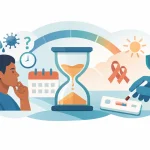

A request for a “standard STD test” sounds straightforward, but there is no single test that checks for every sexually transmitted infection. What STDs are tested in a standard test depends on the clinic, the type of sexual contact involved, whether you have symptoms and how recently a possible exposure occurred.
That distinction matters. A quick urine test may be suitable for one concern but miss an infection in the throat or rectum. A blood test can check for certain infections but not all of them. The most useful screening is not simply the broadest panel available – it is the right set of tests at the right time, interpreted by an experienced doctor.
What STDs are tested in a standard test?
At many private sexual health clinics, a standard screening panel commonly checks for chlamydia, gonorrhoea, HIV and syphilis. These are common infections with clear health benefits from early diagnosis and treatment.
Chlamydia and gonorrhoea are usually tested using a urine sample, a vaginal swab, or both, depending on your anatomy and symptoms. These tests look for the genetic material of the bacteria. They are highly accurate when taken from the correct site.
HIV and syphilis are generally tested through a blood sample. Modern laboratory tests can identify HIV infection earlier than older testing methods, while syphilis blood tests look for signs of current or past infection. A doctor may also recommend hepatitis B and hepatitis C testing, particularly where there has been a relevant sexual exposure, blood exposure, shared needles, a new diagnosis of another STI, or a partner with known infection.
Some clinics describe this as a basic, routine or comprehensive screen. The name is less important than knowing exactly what is included. Before testing, ask which infections are covered, which samples will be taken and whether your recent exposure means you should return for repeat testing.
Why one standard panel does not suit everyone
A standard panel is a useful starting point, not a guarantee that every possible infection has been ruled out. Sexual health testing should reflect what happened, not only whether a condom was used.
If you have had oral sex, a throat swab may be needed to detect gonorrhoea or chlamydia in the throat. These infections can cause no symptoms, yet still be passed to a partner. A urine sample does not reliably exclude a throat infection.
Similarly, receptive anal sex may require a rectal swab. Rectal chlamydia and gonorrhoea can be symptom-free, and testing urine alone can miss them. There is nothing unusual or embarrassing about discussing this with a clinician. Accurate information allows the correct sites to be tested discreetly and without judgement.
Symptoms also change the approach. Genital sores, blisters, discharge, pain when passing urine, a rash, itching or bleeding may require targeted swabs, an examination or additional blood tests. If visible blisters or ulcers are present, a swab from the lesion may be the best way to test for herpes. Waiting for a generic screen can delay a clearer diagnosis.
Infections not always included in routine screening
Herpes, human papillomavirus (HPV), trichomoniasis and hepatitis testing are not included in every standard panel. This is not necessarily a shortcoming. Each infection requires a different testing strategy, and testing is most valuable when there is a clinical reason to do it.
Herpes
Herpes is best tested by swabbing a fresh blister, sore or ulcer. Blood tests for herpes antibodies are available in some settings, but they cannot reliably tell when the infection was acquired or where it is located. For that reason, routine herpes blood screening is not always recommended for people without symptoms.
HPV
HPV is extremely common and often clears without treatment. There is no routine HPV test for most men, and HPV testing in women is usually linked to cervical screening rather than a general STI check. Genital warts should be assessed clinically, even if a previous routine panel was negative.
Trichomoniasis
Trichomoniasis can cause discharge, irritation or discomfort, but many people have no symptoms. It may be added to testing where symptoms, sexual history or a partner’s diagnosis suggest it. It is not automatically included in all basic panels.
Hepatitis B and hepatitis C
Hepatitis B can be sexually transmitted, and vaccination offers protection for many people. Hepatitis C is less commonly passed through sex in many circumstances but can be relevant depending on exposure, sexual practices, HIV status or blood contact. A clinician can advise whether testing and hepatitis B vaccination should form part of your care.
Timing can affect a negative result
Testing too soon after a possible exposure can produce a negative result before an infection is detectable. This period is often called the window period. It does not mean the test is poor – it means the body or laboratory marker has not yet reached a detectable level.
Chlamydia and gonorrhoea are often tested around one to two weeks after exposure, although testing may be appropriate sooner if you have symptoms. HIV and syphilis have longer and variable detection windows. A modern HIV blood test can detect many infections within weeks, but a repeat test may still be advised after a very recent exposure. Syphilis may also need repeat blood testing if the first test was taken early.
The right timing depends on the test used and the exposure. If you are worried about a recent encounter, do not avoid testing because you think it may be too early. A doctor can take an initial test, explain what it can tell you now and arrange any follow-up test needed for a reliable result.
If there was a high-risk HIV exposure within the past 72 hours, seek urgent medical advice immediately. Post-exposure treatment may be time-sensitive.
What happens during a private STD check?
A proper sexual health consultation should be brief, confidential and practical. You will be asked about symptoms, recent partners, the type of sexual contact involved, condom use, previous STI history and when the exposure happened. These questions are clinical, not personal judgement.
The doctor then recommends the samples needed. This may include blood, urine, vaginal swabs, throat swabs, rectal swabs or a swab from a sore. Not everyone needs every sample. Equally, choosing only a urine test for privacy or convenience may leave important gaps if oral or anal exposure occurred.
Results can often be available within 24 hours for selected tests, while others may take longer. Fast results are helpful, but interpretation matters just as much. A negative result needs to be considered alongside timing and the sites tested. A positive result should lead to clear treatment advice, partner guidance and follow-up where needed.
At Klinik Bangsar South, screening is handled with one-to-one medical consultation, discreet access and specialist-led interpretation, so patients are not left trying to make sense of a laboratory result alone.
When to book testing rather than wait
Book a consultation if you have symptoms, a partner has informed you of an STI, you have had unprotected sex with a new or unknown-status partner, or you simply want reassurance before starting a new relationship. Regular screening is also sensible for sexually active people with new or multiple partners, even when they feel completely well.
Do not self-diagnose based on symptoms or a partner’s appearance. Many STIs have no obvious signs, and several non-STI conditions can look similar. Prompt testing protects your health, reduces the risk of passing an infection on and usually makes treatment more straightforward.
The best STD test is not defined by a package name. It is the test plan that accounts for your exposure, your symptoms and the time since contact – delivered privately, with clear answers and a clinician who can tell you exactly what to do next.