You had sex a few days ago, the condom broke, or you are worried about a new partner. The natural response is to test immediately. But STI testing windows matter: a test taken too soon can be negative even when an infection is present. Knowing when to test helps you get an answer you can trust, without unnecessary waiting or false reassurance.
A private sexual health consultation can clarify which tests are appropriate for the type of contact you had, how long ago it happened, and whether you have any symptoms. This is particularly useful when the situation feels urgent or difficult to discuss.
STI testing windows: what they mean
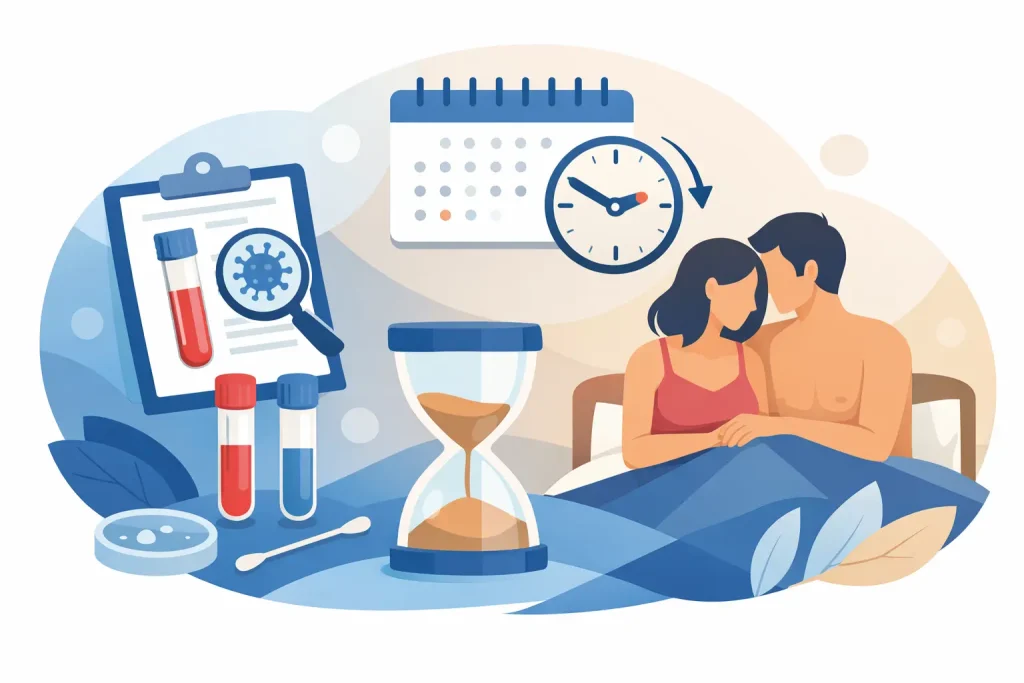
An STI testing window is the time between a possible exposure and the point when a test is likely to detect an infection accurately. During the first days after exposure, an infection may not yet be present in a high enough amount for a swab, urine test or blood test to identify it.
The right timing depends on the infection and the test method. A urine or swab test looks for genetic material from an infection such as chlamydia or gonorrhoea. Blood tests may look for an antigen, antibodies, or both. Your body needs time to produce antibodies, which is why some blood tests have a longer window.
This does not mean you should ignore symptoms or wait silently if you are worried. Testing early can still be useful as a baseline, and a clinician can advise whether a repeat test is needed. If you have discharge, pain when passing urine, genital sores, a new rash, pelvic pain or testicular pain, arrange an assessment as soon as possible.
When can common STIs be detected?
Chlamydia and gonorrhoea
Chlamydia and gonorrhoea are commonly tested with a urine sample or a swab from the throat, genitals or rectum, depending on the sexual contact involved. Testing is generally more reliable from around 7 days after exposure. If you test earlier because of symptoms or anxiety, your doctor may recommend repeating the test at around 2 weeks.
Where the infection can be matters. A urine test does not rule out a throat or rectal infection. Oral sex may require a throat swab, while receptive anal sex may require a rectal swab. Being clear about the type of exposure allows testing to be targeted properly and discreetly.
HIV
HIV testing depends heavily on the type of test used. A laboratory fourth-generation HIV blood test, which detects both the p24 antigen and HIV antibodies, can detect many infections from around 18 days after exposure. Results are considered highly reliable by around 45 days, although a clinician may advise a further test at 3 months in certain circumstances.
If the exposure was within the last 72 hours and could carry a significant HIV risk, do not wait for a testing window. Post-exposure prophylaxis, known as PEP, may reduce the risk of HIV if started urgently. It must be assessed and prescribed quickly.
Syphilis
Syphilis is usually identified through a blood test, although a clinician may swab a suspicious sore if one is present. Blood tests can take several weeks to become positive. Testing from around 3 to 6 weeks may identify an infection, but a repeat test at 12 weeks is often advised after a recent exposure if the earlier result was negative.
Syphilis can cause a painless sore, rash, swollen glands or flu-like symptoms, but it can also cause no obvious symptoms. Do not assume that feeling well means there is nothing to test for.
Herpes
Herpes is different from many routine STI screens. If you have a new blister, ulcer or sore, a swab should be taken as soon as possible, ideally while the lesion is fresh. This is the most useful way to confirm whether herpes is causing the symptoms.
Herpes blood tests have limitations. They may not accurately establish when an infection was acquired, and antibodies may take 12 to 16 weeks to develop. A blood test is not always the best first step for someone with no symptoms, so specialist advice is helpful.
Hepatitis B and hepatitis C
Hepatitis B and C can be sexually transmitted in some situations, though the level of risk varies. The appropriate test and timing depend on your vaccination history, the exposure, and any relevant medical factors. Hepatitis B blood markers may take several weeks to show, while hepatitis C can sometimes be detected earlier with viral testing than with an antibody test. Repeat testing may be advised up to 3 months or longer after exposure.
If you have not been vaccinated against hepatitis B, ask about this during your consultation. Vaccination offers strong protection against future infection.
Trichomoniasis and other infections
Trichomoniasis can be tested by swab or urine sample and is generally more reliably detected from around 7 days after exposure. It is more commonly tested for when there are symptoms, a known positive partner, or a clinical reason to include it in a wider screen.
Not every infection belongs in every testing panel. The aim is not simply to order the largest number of tests. It is to choose tests that match your symptoms, exposure and timing.
Why testing too early can be misleading
A negative result can be reassuring, but only if the test was done at the right point in the testing window. A negative chlamydia test two days after sex, for example, may mean there was no infection before that encounter. It cannot reliably exclude an infection acquired from that encounter.
This is why a specialist may suggest two stages: test now if you have symptoms, want a baseline, or need an initial assessment, then repeat selected tests once their testing windows have passed. This approach is not over-testing. It is how uncertainty is reduced safely.
Avoid taking leftover antibiotics before testing. Antibiotics can reduce detectable bacteria, affect results and make it harder to identify the correct treatment. If you have already taken medication, tell your doctor exactly what you took and when.
Do you need a full STI screen?
It depends on the exposure. A new partner, sex without a condom, a condom failure, multiple partners, a partner with symptoms, or a partner who has tested positive may all justify a broader screen. The tests needed may also differ after vaginal, anal or oral sex.
If you have had an STI before, are on HIV PrEP, or have ongoing sexual contact with new partners, regular screening may be more appropriate than testing only after a scare. Your clinician can recommend an interval that suits your risk and preferences without judgment.
You should also avoid sexual contact, or use condoms consistently, until symptoms have been assessed and any treatment is complete. If an STI is diagnosed, recent partners may need testing and treatment too. This protects you from passing the infection on and from being reinfected.
Private testing with clear next steps
For many people, the hardest part is deciding what to do after a possible exposure. You do not need to work out every testing window alone. At Klinik Bangsar South, private testing is paired with one-to-one medical guidance, so you can understand what your result means, whether it was taken at the right time, and whether any follow-up is needed.
Privacy matters when you are worried about an STI. A confidential appointment gives you space to discuss the encounter honestly, including details that affect which swabs or blood tests are appropriate. Routine results may be available within 24 hours, while some specialised tests can take longer.
If the exposure was recent, do not let uncertainty stop you from seeking advice. The best next step may be testing today, arranging a repeat test for the right date, or getting urgent treatment where time matters. A calm, accurate plan is far more useful than waiting and worrying alone.