A recent sexual encounter can leave you with questions that are difficult to ask, especially if you feel completely well. STD testing provides a clear, private way to understand your health after unprotected sex, a new partner, a condom break, or any situation that does not feel right.
Many sexually transmitted infections cause no obvious symptoms at first. Waiting for a rash, discharge or pain is therefore not a reliable plan. Testing at the right time, with the right tests, gives you useful answers and helps protect both you and your partner.
When should you arrange STD testing?
Testing is sensible after any sexual contact that may have involved exposure to an infection. This includes vaginal, anal or oral sex without a condom or dental dam, sex with a new or multiple partners, sharing sex toys without cleaning or covering them, or discovering that a partner has tested positive for an STI.
You should also arrange a check if you have symptoms such as unusual discharge, pain when passing urine, genital sores, itching, a rash, pelvic pain, testicular discomfort or bleeding outside your usual pattern. These symptoms do not always mean an STI is present, but they should be assessed promptly rather than self-treated or ignored.
For some people, routine screening is appropriate even without a specific incident. If you are sexually active with new partners, screening between partners or at regular intervals can make sexual health care more straightforward and less stressful. The ideal frequency depends on your sexual activity, the types of sex you have, and whether you or your partners have other risk factors.
Why timing matters
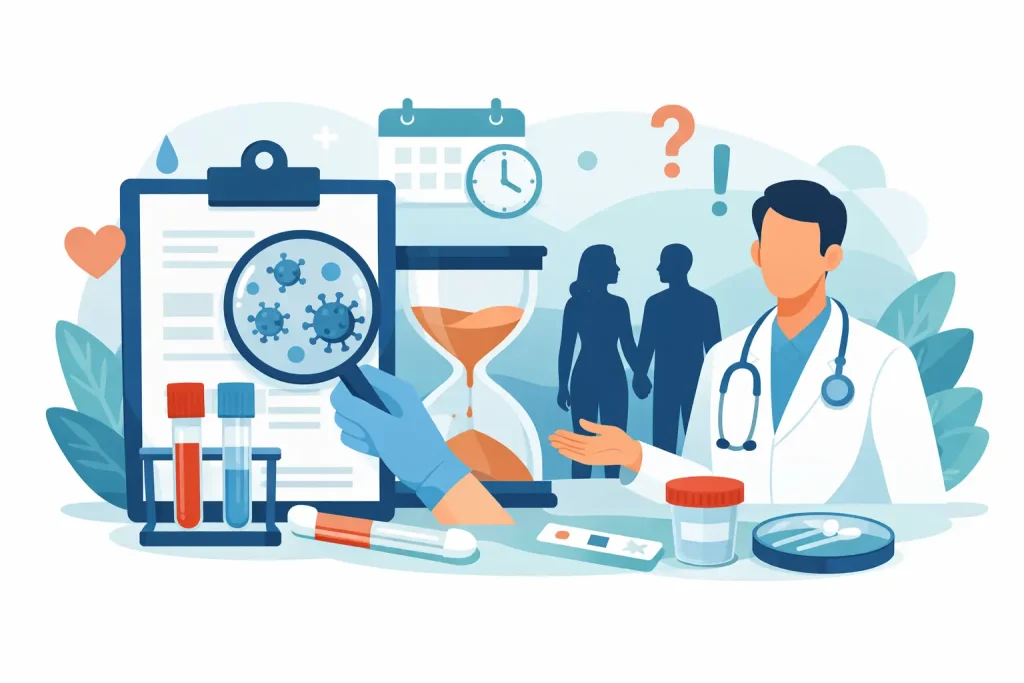
A test can only detect an infection once there is enough of the organism, or enough of your body’s response to it, to show in a sample. This period between exposure and reliable detection is often called the window period. Testing too soon may give a reassuring result that needs repeating later.
Chlamydia and gonorrhoea are commonly checked with a urine sample or swab and may be detectable within days, although testing around one to two weeks after exposure is often more reliable when there are no symptoms. If you develop symptoms sooner, do not wait – see a clinician for assessment.
Blood tests are used for infections such as HIV, syphilis and hepatitis B. The most suitable test and timing vary. Modern HIV tests can detect infection earlier than older tests, but a clinician may still advise repeat testing after a recent exposure. Syphilis can also take time to appear in blood results. A specialist consultation is valuable because the answer is not simply whether you need a test, but which test is appropriate now and whether another check is needed later.
If the exposure was within the last 72 hours and there is a concern about HIV, seek urgent medical advice. Post-exposure treatment may be time-sensitive.
What does an STD test involve?
There is no single test that covers every possible infection in every situation. A proper assessment begins with a confidential discussion about your symptoms, the type of contact involved, when it happened, and any previous testing. This information helps the doctor recommend a focused panel rather than a one-size-fits-all approach.
Depending on your circumstances, testing may involve a urine sample, blood sample, swabs from the throat, genitals or rectum, or an examination of a sore or rash. Throat and rectal swabs matter when oral or anal sex has taken place. A urine test alone may miss an infection at another site.
The process is usually quick. Some samples can be collected by the patient in private, while others need to be taken by a clinician. If an examination is necessary, it should be explained clearly and performed with sensitivity. You are entitled to ask why a test or examination is recommended before agreeing to it.
Tests are chosen around your exposure
A broad screen can be appropriate for someone with several recent partners or unclear exposure history. In other cases, targeted testing is more useful. For example, a painful blister may require a direct swab, while a new painless ulcer may need a different clinical approach and blood tests.
This is why interpreting online test packages without medical advice can be confusing. More tests are not automatically better if they are taken before the right window period, omit a relevant sample site, or create results that are difficult to interpret without context.
What to do before your appointment
Try not to urinate for at least one to two hours before providing a urine sample for chlamydia and gonorrhoea testing, unless the clinic advises otherwise. Avoid applying creams or antiseptics to a genital sore before assessment if possible, as this may affect a swab result.
Bring a clear timeline of recent sexual contact, symptoms and any antibiotics you have taken. Antibiotics prescribed for another condition can sometimes affect test accuracy or symptoms. You do not need to provide every personal detail perfectly – an experienced clinician will ask the relevant questions without judgement.
If you have received a message from a partner advising they have an infection, keep the details available. Knowing the diagnosis can help guide immediate testing and treatment.
Understanding your results
A negative result is reassuring, but its meaning depends on timing and the samples taken. If testing happened very soon after exposure, a repeat test may be advised. Continue using condoms or avoid sex until you have followed the clinician’s advice, particularly if symptoms are present or a partner is awaiting results.
A positive result does not mean you have done anything wrong. STIs are medical conditions, and many are curable with the right treatment. Others can be managed effectively with ongoing care. Prompt diagnosis reduces the chance of complications and makes it easier to protect current and future partners.
Results should come with a clear plan. That may include medication, a follow-up test, abstaining from sex for a defined period, partner notification, or testing for other infections. Do not share prescribed antibiotics or rely on medication left over from a previous illness. The correct treatment depends on the infection, its site and, in some cases, local resistance patterns.
Privacy should not be an afterthought
Embarrassment causes many people to delay care. In practice, sexual health consultations are routine clinical work. A private service should offer discreet access, confidential handling of your information and time to discuss your concerns one-to-one.
At Klinik Bangsar South, patients can access specialist-led screening in a private setting, with discreet parking and prompt result arrangements where clinically available. More than 50,000 tests over 12 years have reinforced a simple principle: people need accurate answers, clear explanations and respectful care, not judgement.
If you are worried about a partner
It can feel awkward to raise testing with a partner, particularly at the start of a relationship. Keeping the conversation factual is often easiest: explain that you are having a check because you value both of your health, not because you are making an accusation.
If you receive a positive result, partners who may have been exposed should be informed so they can test and receive treatment if needed. A clinician can explain who may need contacting and how far back to consider. Some services can also advise on partner notification without disclosing unnecessary personal information.
While waiting for results or treatment, use condoms consistently or pause sexual contact according to medical advice. This is a practical step, not a punishment. It helps stop an easily treated infection becoming one that is passed back and forth between partners.
Do not wait for certainty
You do not need to be certain that an exposure was risky before arranging a consultation. If you are anxious, have symptoms, or simply want a confidential baseline check after a new partner, getting tested is a sensible act of care. A timely appointment can replace weeks of uncertainty with a clear next step.