A condom broke. You had sex with a new partner. You are now replaying the encounter and wondering whether a test tomorrow will give you a real answer. If you are searching for how soon test after exposure, the honest answer is: it depends on the infection, the test used and the type of contact.
Testing too early can produce a negative result before an infection is detectable. Waiting unnecessarily, however, can delay treatment and leave a partner at risk. The practical approach is to test at the right time, test the relevant body sites and arrange a repeat test where the window period requires it.
How soon to test after exposure depends on the STI
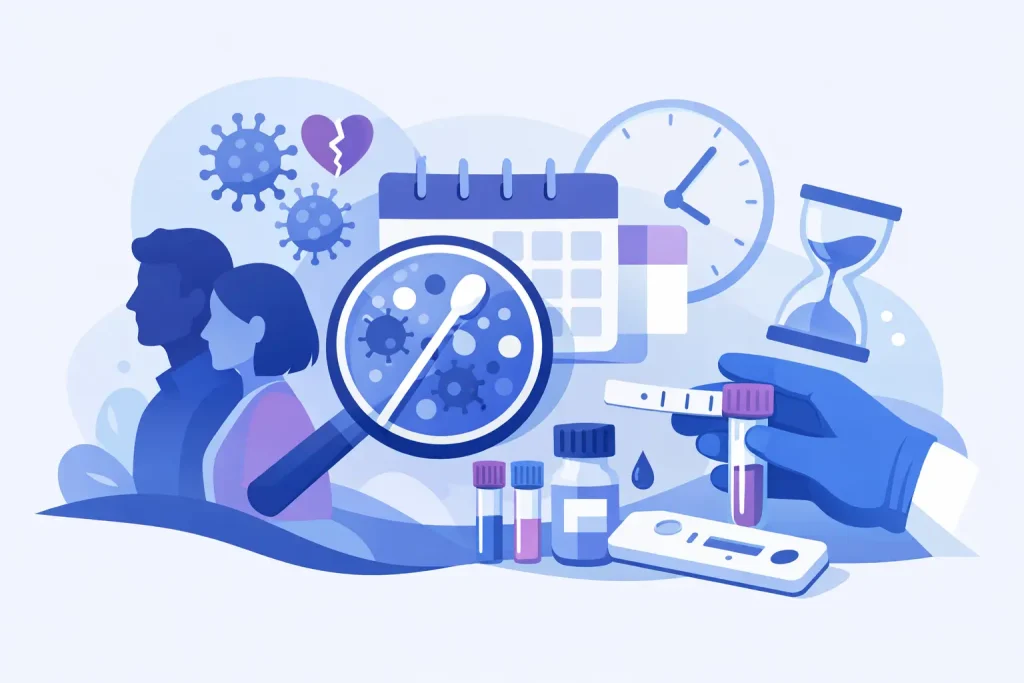
A window period is the time between exposure and the point at which a test can reliably detect an infection. Some infections can be identified within days or a couple of weeks. Others require a later blood test because the body needs time to produce detectable markers.
The dates below are useful general guidance, not a substitute for individual medical advice. A specialist can tailor your testing plan based on the date of exposure, whether sex was vaginal, anal or oral, whether a condom was used, and whether you have symptoms.
| Infection | When testing may be useful | When a result is usually more reliable | |—|—|—| | Chlamydia | Around 7 days after exposure | 14 days after exposure | | Gonorrhoea | Around 7 days after exposure | 14 days after exposure | | Trichomoniasis | Around 7 days after exposure | 14 days after exposure | | HIV, laboratory fourth-generation test | From around 18 days | Around 45 days, depending on the test and clinical advice | | Syphilis | From around 3 to 6 weeks | Repeat testing may be advised at 12 weeks | | Hepatitis B and C | Varies by test and exposure | Often requires follow-up blood tests over weeks or months |
These windows are not a reason to ignore symptoms. A test may be needed immediately if you have a discharge, burning when passing urine, sores, a rash, genital pain, unusual bleeding or swollen glands. A clinician can examine you, take the appropriate samples and decide whether treatment is needed before every result is back.
Chlamydia and gonorrhoea: usually test at two weeks
Chlamydia and gonorrhoea are common, often symptom-free and readily treatable when found early. A urine sample may be appropriate for some patients, but it does not cover every possible site of infection.
If you had oral sex, a throat swab may be needed. If you had receptive anal sex, a rectal swab may be needed. This matters because throat and rectal infections can have no symptoms and may be missed if testing is limited to urine alone.
Testing at around one week can be reasonable if you are worried or symptomatic, but a negative result this early may need repeating. At two weeks after exposure, testing is generally more dependable. Do not take leftover antibiotics or medication from another person before testing. It can partially suppress an infection, complicate diagnosis and contribute to antibiotic resistance.
HIV: the test type matters
Not all HIV tests have the same window period. A laboratory fourth-generation HIV blood test looks for both HIV antibodies and p24 antigen. It can detect many infections earlier than an antibody-only or some rapid tests.
For a recent potential HIV exposure, a test now may still be useful as a baseline, especially if you have not tested recently. It cannot rule out an exposure from only a few days ago. Your clinician may recommend a fourth-generation laboratory test at an appropriate interval and a repeat test at around 45 days, or later where indicated.
If the exposure was within the last 72 hours, do not wait for a routine screening appointment. HIV post-exposure prophylaxis, known as PEP, may reduce the chance of HIV infection if started as soon as possible and no later than 72 hours after a significant exposure. Urgent assessment is essential because the treatment window is short.
Syphilis and hepatitis need patience and follow-up
Syphilis is diagnosed with a blood test, but antibodies may take several weeks to appear. A painless sore, rash on the body or palms and soles, swollen glands, or unexplained flu-like symptoms should prompt an earlier clinical assessment. A sore can also be swabbed in some circumstances, which may help before blood tests become positive.
Hepatitis B and hepatitis C testing is more individual. The right tests and follow-up timing depend on the nature of exposure, vaccination status and any known information about the partner. If you are unsure whether you have been vaccinated against hepatitis B, raise this during your consultation. Vaccination and, in some situations, urgent preventative treatment may be relevant after a recent exposure.
Herpes is different: seek review if you have a sore
There is no simple routine screening test that can reliably tell you whether a recent exposure caused genital herpes. Blood tests do not reliably date an infection and are not usually the first choice after a single encounter.
If you develop blisters, ulcers, tingling followed by a rash, or painful genital sores, arrange an examination as soon as possible. A swab from a fresh lesion is the most useful way to investigate suspected herpes. Do not wait for lesions to heal before seeking care.
What to do if you have symptoms today
A window period applies to screening after an exposure when you feel well. Symptoms change the situation. You should be assessed promptly if you notice genital sores, discharge, pain when passing urine, testicular pain, pelvic pain, rectal pain or bleeding, a new rash, or fever after a sexual encounter.
Severe lower abdominal or pelvic pain, severe testicular pain, fever with a rash, or a possible sexual assault require urgent medical attention. These symptoms are not always caused by an STI, but they should not be managed by waiting for an online test kit or hoping they settle.
Until you have clarity, avoid sex or use condoms and barriers consistently. If an infection is diagnosed, your clinician can advise when it is safe to resume sex and whether recent partners should be tested or treated. This is about protecting your health and theirs, not assigning blame.
A sensible testing plan after a recent encounter
For many people, the most reassuring plan is not a single rushed test but a staged approach. An initial appointment can check for symptoms, establish your recent testing history and identify which samples are needed. Testing for chlamydia and gonorrhoea at around two weeks may be combined with blood testing at the intervals appropriate for HIV, syphilis and hepatitis.
The details matter. A negative urine test does not rule out a throat infection after oral sex. A negative HIV test taken too soon does not rule out a very recent exposure. Equally, one encounter does not mean you have acquired an STI. Specialist interpretation helps you understand what a result does and does not tell you, without unnecessary panic.
At Klinik Bangsar South, consultations and screening are handled privately, with testing selected around your specific exposure rather than a one-size-fits-all panel. If you are anxious, bring the date of the encounter, the type of sex involved, any protection used and details of symptoms or previous tests. That information allows the doctor to give you a clear, practical timeline.
You do not need to wait until you feel completely certain before asking for help. The right next step is a confidential assessment now, followed by testing at the points when the answers will be meaningful.