Confidential STD Testing & Screening in Bangsar South
Accurate, discreet, and non-judgmental sexual health evaluations. Whether you have concerning symptoms or simply desire routine assurance, our experienced doctors provide clear answers quickly.
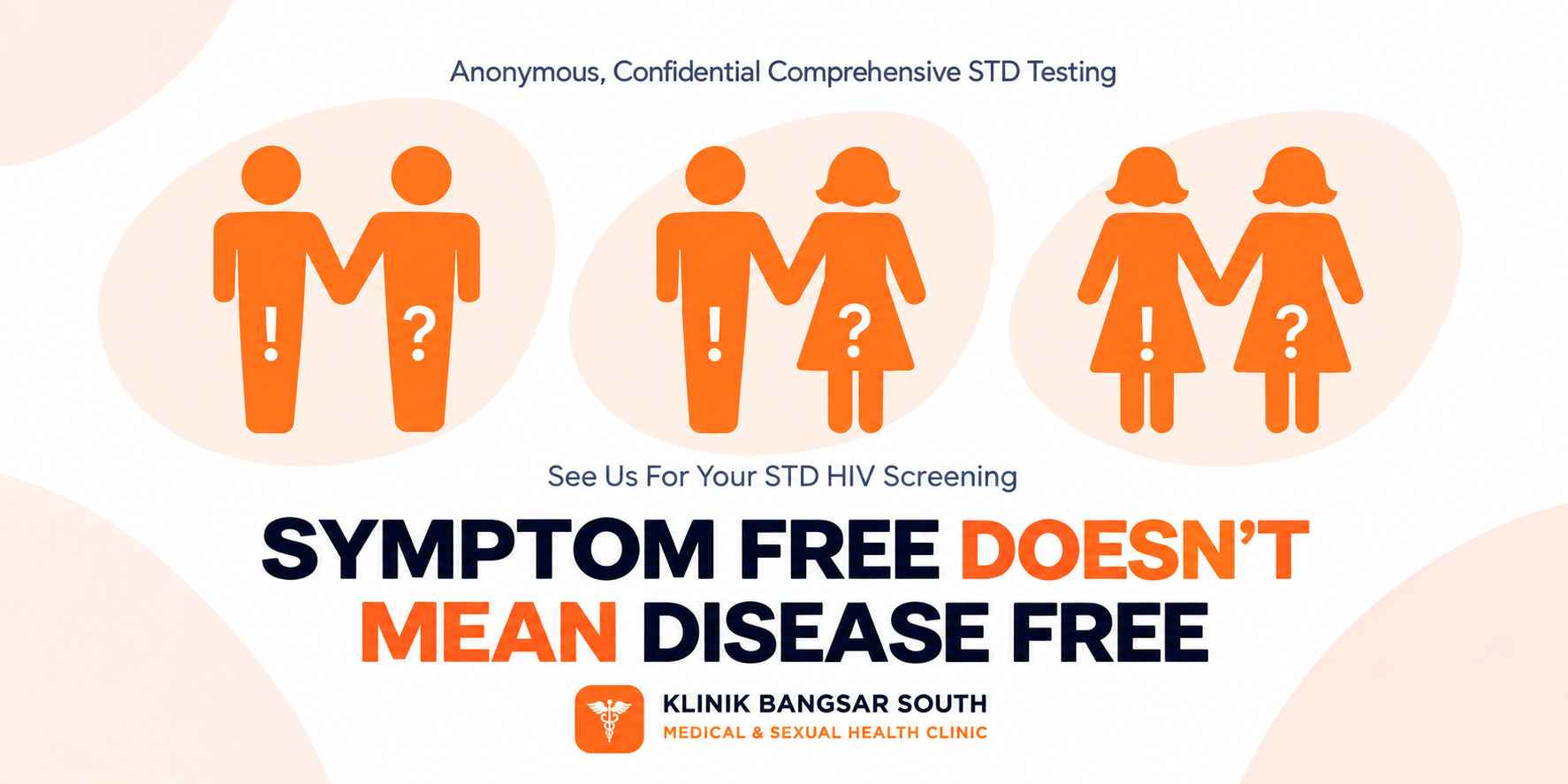
Some sexually transmitted infections have no noticeable symptoms. A confidential conversation with a doctor can help you decide whether testing is right for you.
Testing can be useful after a possible exposure, when you have symptoms, before a new relationship, or as part of routine sexual health care. A doctor can help you choose appropriate tests and timing.
Testing options
Our STD Testing Options
Choose the testing option that best suits your situation. Our doctors can recommend the appropriate tests based on your history, symptoms, exposure and clinical findings.
01
STD & HIV Blood Screening
A comprehensive blood screening covering some of the most common sexually transmitted infections.
✓ HIV — 4th Generation ELISA
✓ Syphilis — VDRL & TPHA
✓ Hepatitis B — HBsAg & antibodies
✓ Chlamydia antibodies
✓ Herpes Simplex Virus — HSV-1 & HSV-2
02
Comprehensive STI PCR Panel
Highly sensitive PCR testing using urine or swab samples to detect common bacterial and parasitic STIs.
✓ Chlamydia trachomatis
✓ Neisseria gonorrhoeae (Gonorrhoea)
✓ Trichomonas vaginalis
✓ Mycoplasma genitalium & Mycoplasma hominis
✓ Ureaplasma urealyticum & Ureaplasma parvum
03
HPV DNA PCR & Genotyping
HPV testing available for both men and women, with DNA detection and genotyping to identify specific HPV types.
✓ HPV DNA PCR testing
✓ HPV genotyping
✓ Available for men & women
04
Genital Ulcer PCR Panel
PCR screening designed to identify infections that may cause genital sores, ulcers or similar symptoms.
✓ Herpes Simplex Virus Type 1 & Type 2
✓ Varicella Zoster Virus & Cytomegalovirus
✓ Haemophilus ducreyi
✓ Treponema pallidum (Syphilis)
✓ Lymphogranuloma venereum (LGV)
05
Urethral and Cervical Smear Testing
On-site testing for patients with symptoms such as urethral discharge, irritation or discomfort.
✓ Cervical/urethral smear examination
✓ Available on selected mornings
✓ Same-visit results
Recommended combined screening
Broader screening, tailored to you
Several tests can be combined depending on your individual risk factors and clinical needs.
Comprehensive STD & STI Screening
✓ STD & HIV Blood Screening
✓ Comprehensive STI PCR Panel
Most comprehensive screening
Comprehensive STD & STI Screening
✓ STD & HIV Blood Screening
✓ Comprehensive STI PCR Panel
✓ HPV DNA PCR & Genotyping
Additional testing
Additional urine, swab and PCR investigations are also available. Your doctor will recommend the most appropriate tests based on your exposure, symptoms and examination.
Please hold your urine for at least 1 to 2 hours before providing your sample at the clinic. The first-catch urine contains the highest concentration of organisms.
2. Blood Testing (HIV, Syphilis, Hepatitis)
No fasting is required for standard sexual health blood panels. You may eat and drink normally before attending.
3. Active Symptoms or Sores
If you have active genital sores or discharge, do not apply any topical creams or antiseptic washes on the day of your visit so swabs can be accurately taken.
A window period is the time between a possible exposure and when a test can usually detect HIV. These ranges are general information, not a diagnosis or a personalised testing schedule.
Nucleic acid test (NAT)
10–33 days
Usual detection window after exposure
Looks for the virus in a blood sample. A doctor may recommend it in particular circumstances; ask about availability.
Laboratory antigen/antibody test
18–45 days
Usual detection window after exposure
Uses blood drawn from a vein. Sometimes called a fourth-generation or combination test.
Rapid antigen/antibody test
18–90 days
Usual detection window after exposure
Uses blood from a finger prick. Its window period differs from a laboratory combination test.
Antibody test
23–90 days
Usual detection window after exposure
Most rapid tests and self-tests are antibody tests. Check which test you are using with your provider.
What these ranges mean for you
No HIV test detects infection immediately. A negative result within the window period may need follow-up. These ranges describe testing in the absence of antiretroviral medication; tell your clinician if you use or recently used PEP or PrEP. A reactive result needs follow-up testing.
This guide does not determine whether you have an infection, assess exposure risk, or confirm which tests the clinic currently offers. A clinician can help you choose the test and timing.
Your questions, answered
Questions about testing
Still unsure? We are here to help you take the next step.
There is no single panel that answers every concern. Your doctor will discuss symptoms, the type and timing of exposure, and appropriate blood, urine or swab tests.
How soon will I receive results?+
Turnaround depends on the test and laboratory. Ask the clinic to confirm the expected time and how your results will be communicated before testing.
Do I need to prepare for a test?+
Contact the clinic before your visit for test-specific instructions. Mention current medication, recent testing and any PEP or PrEP use to your doctor.
Does a negative HIV test exclude a recent infection?+
A test taken within its window period may not detect a recent infection. Follow-up testing may be needed. PEP and PrEP can affect interpretation and testing schedules.